Saying Goodbye To The Kojo Nnamdi Show
On this last episode, we look back on 23 years of joyous, difficult and always informative conversation.

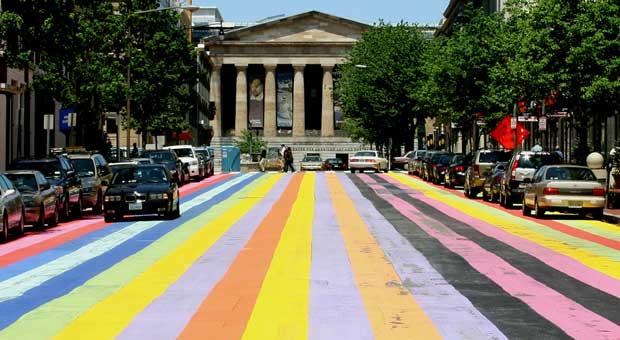
In May 2007, the D.C. Commission on the Arts and Humanities collaborated with the Corcoran to recreate a 1987 project as an homage to Gene Davis.
The recent presidential election re-ignited the debate over government arts funding, including for the National Endowment for the Arts and public broadcasting. As the showdown over how to avoid going over the “fiscal cliff” heats up, the relatively small allocation for cultural programs isn’t making headlines. But many arts organizations are concerned about cuts, while conservatives hope to make a case for the separation of art and state. We explore the future of public arts funding.
MR. KOJO NNAMDIFrom WAMU 88.5 at American University in Washington, welcome to "The Kojo Nnamdi Show," connecting your neighborhood with the world. The recent presidential election reignited the longstanding debate over government funding for the arts. Presidential candidate Mitt Romney memorably called for an end to the national endowment for the arts as well as support for Big Bird. But now that the election is over the focus has shifted to averting the fiscal cliff. And the relatively small allocation of cultural programs is not grabbing the headlines that defense spending and other big ticket items are. But it doesn't mean that the debate has gone away.
MR. KOJO NNAMDIWhile arts organizations worry about where the axe may fall conservatives continue to press their case that the government should not be in the business of funding the arts at all. Joining us to discuss this is David Boaz, executive vice-president of the CATO Institute. David, good to see you again.
MR. DAVID BOAZThank you.
NNAMDIAlso with us in studio is Jonathan Katz, CEO of the National Assembly of State Arts Agencies. It's a membership organization of state and local arts agencies. Jonathan Katz, thank you for joining us.
MR. JONATHAN KATZGood afternoon.
NNAMDIAlso with us is Sarah Slobodien Dovere. She is the director of development at the Woolly Mammoth Theater Company. Sarah Dovere, thank you for joining us.
MS. SARAH DOVEREThanks for having me.
NNAMDIIf you'd like to join the conversation, call us, 800-433-8850. Do you think the government should fund arts organizations or should it be left to private donors, 800-433-8850? David Boaz, let's talk with the basics. What are we talking about when we discuss public funding for the arts at the federal level?
BOAZWell, we talk about the national endowment for the arts and I think also you would include the national endowment for the humanities in there. Each one of those is a few hundred million dollars a year, actually a very small part of all the funding of arts in America. And the argument about it, at least from my perspective, is not whether I object to any particular piece of art but just whether art should be entangled with government.
BOAZGovernment is inherently about coercion, about taking money from people to use for what some people regard as public purposes. And government money comes with strings. And I believe in the separation of church and state for the same reason I believe in the separation of art and state.
NNAMDIAnd we will get to that argument more in a second. But Jonathan first, what kind of funding exists at the state level and what is the relationship between state's arts agencies and the federal governments?
KATZWell, at the state level the amount from legislatures varies greatly from state to state. And if you add up all the state budgets in the territories -- the six territories, Guam (unintelligible) American Samoa, Puerto Rico, the Virgin Islands and the District of Columbia and the 50 states, this year it's about $280 million from state legislatures. And that' supplemented by a portion of the budget of the national endowment for the arts. By a law 40 percent of the budget of the national endowment for the arts goes through the states and regions to be distributed equitably amongst the nation. And so that's about $50 million.
NNAMDISarah Dovere, specifically in D.C. which is not a state, what's the public funding for the arts picture like here?
DOVEREWell, we have funding from the D.C. government -- the D.C. Commission on Arts and Humanities. And we also -- because we are in a state we get funding through the federal government through the National Capital Arts and Cultural Affairs Grant Program, which is administered by the Federal Commission on Fine Arts.
NNAMDIDavid Boaz, there has not been a lot of talk about the arts in these fiscal cliff negotiations, as I mentioned earlier. The numbers we're talking about are small in the context of the deficit. But if no deal is made sequestration would mean across-the-board cuts. Presumably that would include arts funding despite the relatively small impact that it would have, correct?
BOAZYeah, that's right. Sequestration would include the arts. It's across-the-board funding except for entitlements programs, which of course are the biggest part of the budget. So it affects defense and it affects none defense discretionary programs that is not entitlement. So yes, there would be a small percentage cut if the fiscal cliff actually happens, if sequestration were actually to happen.
NNAMDIJonathan there are other possibilities too, aren't there, besides sequestration that hits everyone equally? What else could happen?
KATZWell, Congress could decide not to extent the continuing resolution that it's on right now. The continuing resolution goes from October through the end of March and people may decide to take a look at individual agencies and individual budget bills before then. They may decide to avoid sequestration to deal with the federal budget, you know, in a more minute level before then as well.
BOAZYou mean they would actually do their job, but they haven't actually shown an inclination to do that.
KATZWell, it's a remote possibility that could happen.
NNAMDISarah, local arts organizations won't be hit directly but there are concerns. What are they?
DOVEREWell, one of the concerns is what will happen in the budget talks with the charitable deductions. And another concern is what will happen with the funding for the National Capital Arts Program.
NNAMDIYou point out that cuts affect smaller organizations, in particular like yours, the Woolley Mammoth Theater Company. Why?
DOVEREWell, we have a diverse portfolio of support but a piece of that--an important piece of that is the funding that comes from the D.C. government and the National Capital Arts Programming. And we saw in 2011 the cuts to the National Capital Arts Programming resulted in a 70 percent cut for the arts organizations in D.C.
NNAMDI800-433-8850. Are you concerned about cuts to funding for the arts? If so why, 800-433-8850. David Boaz, let's get to it. You've pointed out that he who pays the piper calls the tune. What does that mean when we're talking about government arts funding?
BOAZWell, it means that ultimately the money comes from the government which is to say the taxpayers, which is to say the taxpayers representatives in Congress and the administration. And it means that there is at least the threat of strings there. The defenders of the arts agencies often talk about the imprimatur, the seal of approval that comes from the NEA or the NEH. I don't want the government having an imprimatur or a seal of approval on what is approved art, which artists and art organizations are approved.
BOAZAnd we do know that not all that often but not infrequently we have controversial conflagrations about particular pieces of government-funded art. One of my favorite examples was like 15 years ago when PBS put on a miniseries of Tales of the City, a San Francisco novel -- comic novel that included gay characters. And to some people this was a shocking thing. There were going to be gay characters on PBS.
BOAZAnd so when it came time to talk about doing Tales of the City II PBS shied away from it. I don't think any president or any senate majority leader said do not do that but they knew that it was politically controversial. They didn't want to do it. So who did it? Showtime did Tales of the City II and there's no political uproar about that. Nobody thinks the government or the Congress gets to decide what's on Showtime. So I would just rather leave art in the hands of thousands, tens of thousands of diverse arts groups, television networks, local radio stations and so on rather than have them subject to politicians getting on a high horse about them.
NNAMDIBefore we get to Jonathan, is that what you mean when you call for the separation of art and state?
BOAZYes. And I use that phrase because obviously in America we know the concept of separation of church and state, separation of religion and state. And why do we want to keep government out of religion? Not because religion isn't important but because it is important. It deals with our faith, our values, our spirituality, the deepest place in our lives. And art, if it's done well, also deals with the deepest parts of our soul. And therefore for the same reason I don't want government involved.
BOAZAnd even if there's supposedly protection from the politicians I wouldn't want a bunch of government subsidized churches even if there was a federal commission on churches and a board of church rights and regulations to protect them from the politicians. I want separation.
NNAMDIJonathan Katz, you disagree that government funding equals government control.
KATZWell, I think there's a couple of ways to look at this and one is what does it actually look like when public money is expended on behalf of the arts and cultural activities. And for one thing we're looking at a range of public benefits that derive. And if you were to ask yourself how we get these public benefits you would say the government would play part of a role in making that happen. You would say the government would help make a market. You would say the government would help in the educational function.
KATZAnd it's actually as education that government funds the arts. If you look at the national endowment for the arts and even legislation, that's what the Congress understood it was doing. To -- primarily a matter of private and local initiative is what Congress said. But we fund cultural activity in order to achieve a better understanding of the past, a better analysis of present, a better view of the future.
KATZIn order to promote the skills in its citizens that enable participation of the democratic process people can express themselves as well as they possibly can when they're tutored in their senses. And people can be empathetic which is what you learn when you study drama. The climate encouraging freedom of thought, imagination and inquiry and also the material conditions facilitating the release of this creative talent is what Congress thought a government role would be.
KATZAnd I guess a question is, what does it look like when it's actually administered? Who are these people? Who are these nameless, faceless bureaucrats who are doing this officiating in every level of the state...
NNAMDIGood question. Would you please answer it?
KATZWell, at the state and the federal and the local level they're your neighbors, you know. They are panels -- they are peer panels of your friends. They're people who are knowledgeable about the arts, knowledgeable about the public benefits. And they look at the applications which are in competition to provide public benefits, to enable people to participate in the arts who would not otherwise have that opportunity. Either in a city isolation or rural isolation or they speak a different language where they just got here or they haven't had the education.
KATZAnd all these opportunities become available to them because of that public portion that's not in the marketplace.
NNAMDI800-433-8850. Do you think public money equals government control when it comes to arts funding? Give us a call, 800-433-8850. David, you point out that although it does not happen often there are controversies over what's being funded and that can equal control.
BOAZWell, that's right.
NNAMDISpecifically about the National Gallery exhibit in December of 2010 called Hide/Seek.
BOAZRight. There was an exhibit on sexual difference in portraiture, an interesting concept. And the most controversial thing in it were some portraits -- or actually I think they may have been videos by David Wojnarowicz and there was a lot of outrage about these. They were perceived as sacrilegious, too homoerotic, that sort of thing. And eventually the National Gallery backed down and they pulled these out. And a lot of arts establishment people were very upset about that.
BOAZBut the National Gallery was looking at government funding, potential government control. No doubt from their own point of view they figured a little bit of accommodation to the politicians would save them from more severe repercussions. That's the kind of thing I would rather not see. And, you know, when you set it up as does government funding equal government control, well, it's easy to say, no, no I've done lots of things and I've never had any government control.
BOAZMaybe the right term is what journalists use a lot, chilling effect. We know there can be a chilling effect when government gets too close to the news business in lots of countries in the world, but also in Supreme Court cases in this country. We talk about a chilling effect on free expression. I worry about a general chilling effect, but I think you also have to worry about if you're a democracy don't the voters get to decide how they'll spend their money? And if they do then that means when they don't like Tales of the City or Piss Christ or The Hide/Seek Exhibition, they have some way of making their voice heard in a democracy.
NNAMDI800-433-8850. Do you think public money can have, well, a chilling effect on the arts, 800-433-8850. Jonathan Katz, it's an old debate going back to the Regan years. Many people remember controversies over NEA funding of Robert Mapplethorpe and other artists whose work some deemed offensive. What are your thoughts on those controversies?
KATZI think they've really helped the public understand better what the values of the arts are and what the values of government role in making the arts more available to people are. I think the debates have resulted in an engagement on these issues. It's very healthy in American society.
KATZBut I do think that there's a big difference between government support of religion, government support of music and government support of the arts because we're not asking people to worship the art. We're not asking people to worship the music. We're making these things available to them and we study things -- it's an educational enterprise. It's a civic education enterprise and we do study comparative religion. We do study music. We do study art. And we do want people to have these skills as well as these experiences available in their lives.
NNAMDISarah Dovere, care to share your thoughts on these controversies?
DOVEREWell, I mean, that I think that the arts provide an important service in our community. We see that with our work at Woolly Mammoth. Our outreach to the Penn Quarter and to the residents across the city are gaining skills and learning from the work that we're putting on our stage.
NNAMDIDavid, before I go to the phones, D.C. is home to the Smithsonian Museums, the National Symphony Orchestra, all are appreciated by many Americans as part of our national heritage as art belonging to all of us. Do you put those institutions in a different category? And if so why?
BOAZWell, I think politically you absolutely do. The Smithsonian is there. It's always been there. It was originally founded with a grand from a private donor but of course that money was spent long ago. So ideally from a libertarian perspective, yes, I would rather have museums be in the private sector. But I don't think in any upcoming budget fight we're going to be talking about privatizing the Smithsonian.
BOAZAnd even at the Smithsonian we have fights like the fight over the Enola Gay exhibit that some people found too anti-American. And again, when you're the voters and the taxpayers and they put up what you perceive as an anti-American exhibit at the National Air and Space Museum, politicians are going to play to that sentiment.
NNAMDIOn to the...oh, Jonathan, before I go to the phones.
KATZYeah, I just -- part of the health of this debate is that David -- and I really agree on the goal of freedom of expression. And I think it's a very useful debate to think of how we get to enable a people to express themselves freely. And I would argue that it's by giving them the tools to create, making sure that the arts are included in education, which is a public enterprise and thinking of the arts as a public good.
KATZBecause if anybody gets those experiences, anybody's able to make a living better, to be a better parent, to work better, to compete in the global workforce, use technology visually, all of these skills are things that you want there to be a locus both in the private sector for leadership and in the public sector for leadership.
NNAMDIOn to the telephones. Joe in Rockville, Md. is first. Joe, you're on the air. Go ahead, please.
JOEYeah, thank you. A couple things. So much of my experience, when I was a young lawyer, I was one asked to do pro bono work for an opera company and for a theater company, both very famous here in D.C. back then. And I said, pro bono, interesting. Who goes to these places? It's rich -- upper middle class and rich people go to these places. Both of these institutions were also receiving federal funding.
JOEAnd I learned very quickly that a lot of this is really just upper middle class entertainment subsidy. Now I know people will say, well we do inner-city programs and people learn how to express through arts and all this other kind of stuff. That may be valid but it's also valid that they do that through a lot of other avenues. And also to the point that Mr. Katz was saying is, well you find a lot of controversial art subsidized by the federal government.
JOEI doubt you could find one piece of art subsidized by the federal government that from a cultural perspective -- and I don't agree with this but it's a good example -- expounding the dangers of homosexuality through an artistic display or expounding the glories of Catholicism through an artistic display. People would be screaming bloody murder that this was establishment of religion and everything like that. And yet somehow these -- and also when you say these people who choose the art are your neighbors and friends, come on. I doubt you will find very few...
NNAMDIJoe seems to be suggesting, Jonathan Katz, that you will not get an anti-homosexual piece of art and find it being supported by government funding anyplace. You will not find a piece of art that promotes religion and find it getting government funding anyplace. To which you say what?
KATZTo which I say you will certainly get plays and literature and visual art that have religious themes, that have things that bring up issues of gender and preference and you'll see them played out. It would be hard to imagine an evening of diatribe on either side of that. That would be entertaining and that would be good art.
BOAZWell, now Jonathan, let's listen to the caller. It is true that a number of the controversies that have come up have related to sexual orientation because that, over the past decade, has remained a very controversial subject. And so things like Mapplethorpe, things like the Hide/Seek exhibit, Tales of the City, isn't the caller right that although we can name several of these essentially pro-gay pieces of art, you cannot name any government subsidized antigay work of art.
KATZLet me think about that. And I don't know actually that the art is chosen because it's pro-gay or anti-gay. It's chosen because that would be viewpoint discrimination. That isn't even legal.
BOAZWell, it may not be legal but I think that's what I meant by chilling effect. I think the caller's right, and I agree with the caller's implication. I'm not looking to see anybody put out any anti-gay art and I'm certainly not looking to have my tax money paying for it. But I do think antireligious is a theme that makes the cut in government subsidized art. And pro-religious is probably not. Pro-gay is, anti-gay is not.
KATZAnd I would disagree with that. I think that if you were to look at the art that's funded you would see perspectives that are pro-religious and a great deal of the art that's funded. And in fact you would even see a lot of art that takes place in religious venues. It's just not worship. It explodes religious issues.
NNAMDIThank you very much for your call. Here's Bob in Falls Church, Va. Bob, your turn.
BOBThank you very much. A few points, which I'll try to make as quickly as possible. First, if you look back at the history of the arts, you find that going back a couple of hundred years if you were Hayden you had (unintelligible) from your music. (unintelligible) era was probably part of a governmental structure. We just perhaps didn't call it that back in those days. And, you know, to say that today government shouldn't fund art because it should be in the hands of private philanthropy I think is a little historical.
BOBSecond, it's important to really look at the effects here on small arts organizations. If you're the Kennedy Center you can get somebody to give you 200 -- $2 million to build an organ. If you're the Pickwick Players in Lowden County and you get a full amount from the Lowden Council on the Arts to put on a production of the Unsinkable Molly Brown -- I just got an email about that this morning -- then you're not in the same position.
BOBThe wealthy philanthropy is not going to go the small local arts organizations. And they're the ones who are largely putting on local dance, local theater, local music for whom the issue of the availability of government funding can be a matter of life or death for the organization. And that's worth considering when you look at the role of the arts throughout our community.
BOBAnd finally I must say that I've always admired the CATO Institute for its consistency in putting its mouth where its money is. It seems to me that what the issue here is not so much government funding for the arts but a view of the role of government in general which I think many of us can find good and profound reasons for disagreeing with. Thank you very much.
NNAMDIThank you very much for your call. I'd like to hear your response to the caller, Sarah.
DOVEREWell, I think that it is exactly true that with smaller organizations funding does make a really big difference. And I think that what we're seeing in light of what happened with National Capital Arts Funding and other sources of government funding that organizations, small and medium sized are looking outside of government. They're looking to increase individual support and foundation support and corporate support but that the government does play an important piece of that pie of funding.
NNAMDIGot to take a short break. When we come back, we will talk about what seems to be evolving as an alternative method of funding the arts before we get back to the debate that we are currently having. If you've called, stay on the line. We will get to your call. If the lines are busy go to our website kojoshow.org and join the conversation there. Or you can send us email to kojo@wamu.org. Do you think the current tax breaks for donations to the arts should be on the table? You can also send us a Tweet at kojoshow. I'm Kojo Nnamdi.
NNAMDIWelcome back. We're discussing the pros and cons of public arts funding with Jonathan Katz, CEO of the National Assembly of State Arts Agencies, Sarah Slobodien Dovere is the director of development at the Woolly Mammoth Theater Company and David Boaz is the executive vice-president of the CATO Institute. And joining us now by phone from New York City is Yancey Strickler, cofounder and head of community at Kickstarter, a funding platform for creative projects. Yancey Strickler, thank you very much for joining us.
MR. YANCEY STRICKLERThanks for having me. I'm really excited about it.
NNAMDIYancey, for those who are not familiar with it can you tell us a little bit about Kickstarter? What can be funded and how does it work?
STRICKLERYeah, Kickstarter is a website where filmmakers and musicians and artists and writers and people from all across the creative spectrum come and raise money for their creative projects. So a typical project is someone say making a documentary or putting on a performance of a play. And they're raising the funds to make it directly from their audience and from the public. So the site is still...
NNAMDIOh, oh, we seem to have lost Yancey Strickler. We will get back with Yancey Strickler about that alternate method. But where he was going, David Boaz, is that a direction that you approve of?
BOAZOh, absolutely. That's private funding. Many people get to be involved. It brings more funders in. I think that's a great idea and that's one of the things the internet can do for all sorts of projects is bring more people to a direct connection. The internet actually brings arts to more people. You can watch art in Mayfield, Ky. where I grew up that will never come there in person. And so that's a great thing about the internet. But these innovative ideas for using them for funding, for micro lending, things like that, also great.
NNAMDIHas Woolly Mammoth participated in anything on Kickstarter so far, Sarah?
DOVEREWe have not participated in anything on Kickstarter. We have participated in other social media fundraising initiatives and done social media fundraising initiatives through our own website and through the theater. We participated in the first ever giving Tuesday after Thanksgiving where we brought together our community and were able to raise $10,000 on the Tuesday after Thanksgiving.
NNAMDIJonathan Katz, I'm assuming that you don't have an objection to Kickstarter's role in expanding the pool of individual donors to the arts. And what about the idea that this kind of funding model allows artists complete freedom, no strings attached?
KATZI think it's a great funding model and I think it's a great supplement to the other funding models that exist there. It doesn't compete with the reasons that public funding for the arts is important, which for instance are sustainable benefits that have to do with economic development and have to do with people's ability to develop skills over a period of time and education. Have to do with strengthening communities. It's great for innovation. And in fact we're seeing state and local arts agencies use crowd sourcing and the Kickstarter method to achieve public purposes.
NNAMDIYancey Strickler is back. Welcome back, Yancey. You were in the process of explaining how Kickstarter works -- what it funds and how it works.
STRICKLERYeah, I'm not sure where I got cut off. Sorry about that but, yeah, I mean, it's a site where individuals are able to put their ideas out there and invite the public to get involved. You know, they're really proposing things they'd like to see exist, things they'd like to create. And people are basically deciding whether or not they believe that they should happen. So it's very democratic and it's very -- you know, it's really kind of a meritocracy.
NNAMDIIf a project does not reach its financial goal it's my understanding then no money changes hands. Better luck next time, right?
STRICKLERThat's exactly right. So all the funding is all or nothing. So when you create a project you set a budget that you need. And if you reach your budget by your deadline the money is yours and you go bring your project to life. And if you come up short, no money changes hands. We build the model in this way because it always people to take risks pretty easily. You know, as a backer, I'm only charged -- if everyone else agrees that an idea is good and as I'm the creator on the sense about whether or not to do something, I can see whether or not people really like it. (unintelligible) method...
NNAMDIWe should mention...
STRICKLER...go ahead, sorry.
NNAMDI...we should mention that Kickstarter is for profit, that if indeed the project meets its goal in funds than Kickstarter takes 5 percent of the donated funds, correct?
STRICKLERThat's right. We charge a 5 percent fee of what is raised. We take no ownership or equity in the work whatsoever. It's the artists and creators there, you know, until eternity. And so that 5 percent fee is really a great deal and certainly better than an artist can get in pretty much any other method.
NNAMDIWell, back to the issue at hand, earlier this year a comment of yours sparked some debate about arts funding and the role of a company like yours. You said that Kickstarter was on track to distribute more funding to the arts than the NEA. First have you hit that number?
STRICKLERYes, we have. This year we'll end up distributing somewhere around $300 million to creators all around the country.
NNAMDIAs a lot of people have pointed out it's also not an apples-to-apples comparison though when you talk about the NEA because Kickstarter is not itself funding any projects. You simply facilitate funding by individual donors. And Kickstarter also funds for profit projects. The Museum of Modern Art announced that it's including video games as art.
STRICKLERThat's right. Yeah, I mean, I think that we take a very broad notion of what creativity is. I mean, I think now that if you're a creative person you're addressing yourself not just through visual arts or theater. You're also using technology and design and games and things like that. And our creative universe encompasses all of those things.
STRICKLERBut people are certainly right that the uses and purposes of the NEA and Kickstarter are fairly different, but there are some similarities. You know, both institutions stand for more art and creativity existing in the world. You know, all of our work is done in a very public way and is really on a project and a creator level, whereas NEA's work is more supporting other organizations and an awareness of art and culture in our society. But I think that we're -- you know, we're pretty good paring.
STRICKLERAfter those comments earlier this year I actually went down to D.C. and spent a day at the NEA meeting with a lot of their folks there. And we talked a lot about their approach to funding and our approach. And we have a lot of artists that we both worked with. And I think for both of us we're just really interested in seeing more funding going to the arts.
STRICKLERYou know, what's really encouraging about Kickstarter, that's over $400 million that everyday people from around the world have contributed to creative projects. Many of them (unintelligible) ...
NNAMDIYou mentioned contributed -- you mentioned contributed but aren't people in fact investing in these projects through Kickstarter? And if so what do they kick in return?
STRICKLERIt's not investing because there's no ownership that changes hands. But they are contributing money and they are getting rewards, acknowledgement and thank you and an experience in return. You get to watch the project come to life and you really kind of have a claim over it. You have an emotional ownership of this thing that ends up existing.
STRICKLERSo certainly it's not a straight donation in that way. There is some level of self interest involved but I think largely people are excited to see something happen, to see something get created.
NNAMDIAre free tickets involved in the deal the very least when the event occurs?
STRICKLERIt's up to each creator what they want to offer. You know, sometimes they might be -- you know, you get a pair of tickets to the show. It could also be you get to go to the rehearsal or, you know what, we're going to name the villain after you in tonight's performance. It's up to each person what they want to offer and how to structure it.
NNAMDIYancey Strickler is head of community and the cofounder of Kickstarter, a funding platform for creative projects. Yancey, thank you so much for joining us.
STRICKLERAll right. Thank you for having me.
NNAMDIIt seems that this is tapping into, or even developing a new class of arts patrons. Do you feel this is the future of arts funding, at least in part, Sarah Dovere?
DOVEREIt is definitely a part, and it continues to play an increasing role in funding. You know, at Wooly Mammoth Theater, we have both donors that have been with us for a very long time, and we have donors that are new to us, and younger donors that are just starting to be philanthropic, and this is a great way and a great platform for them to start to get involved. And then as they become more involved, we hope that they'll continue to grow with us and learn with us and down the line they'll become, you know, our big sponsors and supporters.
NNAMDIJonathan Katz, if arts funding should be as broad as possible, government, as well as private, where do you see Kickstarter fitting in?
KATZWell, it fits in where it is now. It's in -- and where it might go. More and more individuals seeing themselves as creators, as co-creators with artists and valuing that process. And I think your question about investment, Kojo, is very telling, because people -- individuals will pick what they like and what they enjoy doing and what seems to give them pleasure. When you look at the public expenditure for the arts, you're looking at something that definitely is an investment.
KATZIt goes through the budgeting process. People are asking about the costs and benefits. They want to know who's going to be educated, who's going to be reached, who otherwise wouldn't be reached, what organizations are going to produce revenues that otherwise wouldn't produce revenues. So you have that public hearing and strategic planning and open process in which a community, whether it's a state or a locality, or a nation, looks at what's going to be important in the future of its life, and collectively makes an investment to make that happen.
KATZSo when you look at what actually happens, I mean, I just picked up a stack of programs on the way out of my office, and I'm looking at a program in Rhode Island that State Arts Agency does that facilitates field trips to museums, concert halls, and theaters statewide, and uses a bus to do that. You know, North Carolina Arts Council has a program to make the arts available to people with disabilities and older adults. People in health care environments. I'm looking at Arizona.
NNAMDIWell, allow me to interrupt...
KATZSure.
NNAMDI…because my question to you, David Boaz, is that can North Carolina just as easily submit a request on Kickstarter and would you see that as being an appropriate way for the future of funding arts programs?
BOAZWell, North Carolina certainly could do that. Lots of people are doing it. As Yancey said, it's three or $400 million that they've raised so far for the arts, and, you know, the last time I did a calculation, government fund -- well NEA funding was two-tenths of one percent of total non-profit arts funding. So 99.8 percent of the funding comes from other sources, and now with Kickstarter matching the NEA, I guess that puts it up to 99.9 percent of all the funding for the non-profit arts, and America has a very robust arts world, and it's most not non-profit.
BOAZIt is mostly for profit arts. And so even the 99.8 -- 99.9 percent that's non-government is a small part of the total funding for the arts in this country. So I don't even understand why it's such a tiny amount of money. You can say why should you care about it as fiscal conservative, it's such a small amount of money, but as an artist, why fight over one-tenth of one percent of all the funding for the non-profit arts?
NNAMDIYour turn, Jonathan Katz.
KATZBecause of the huge impact it has and what it says about the investment that a society makes and the skills that it takes to perpetuate a democracy and perpetuate any individual voice that a child will have. That there's a locust of leadership for arts education in our schools. That's a locust of leadership for the inclusion of environmental planning and thinking about environments. That our work force will be prepared -- you know, when you ask technology graduates what they want to do in their career, they say web design, they say environmental planning, they say video games.
KATZThey say these -- they talk about these skills that they wish they had in school, and they wish they were an avenue for them, and these are not equally distributed. There are many kids whose schools don't offer that to them, and there are many people who don’t have available to them theater or symphony or dance in their lives because it's just not -- it's distant, or it costs too much, or they don't -- they don't have enough money or they just got here. And what public funding is about is equity.
NNAMDIDavid Boaz, public opinion generally is more favorable to funding arts education than arts in general. Does your position on government funding apply just as well to arts education?
BOAZWell, look, as long as we've got government schools, then we're going to teach arts and mathematics and physical education and history and all sorts of things, and I guess if I had my choice you teach kids to read, write, and figure before you worried too much about arts education. And since our schools are not doing a very good job, I can tell you as someone who receive cover letters and resumes from recent college graduates, I wish they would teach them to write coherent paragraphs. But as long as you've got schools, arts education will be a part of that.
NNAMDIAnd Sarah, do you think that models like Kickstarter are changing the future of arts support?
DOVEREI think they're having a major impact on arts support. We see at Wooly Mammoth younger donors are -- really want to see the results that their funding is supporting, and they want to see outcomes, and they want to see the impact that their support is making, and programs like Kickstarter allow that to happen. So especially for young professionals that are just starting to be philanthropic, it has a major impact on how they're giving.
NNAMDIGot to take a short break. When we come back, we'll continue this conversation on public arts funding, or not. 800-433-8850. I'm Kojo Nnamdi.
NNAMDIBack to conversation on public arts funding. We're talking with Sarah Slobodien Dovere, director of development at the Wooly Mammoth Theater Company. David Boaz is the executive vice president of the CATO Institute, and Jonathan Katz is the CEO of the National Assembly of State Arts Agencies. That's a membership organization of state and local arts agencies. Jonathan, you heard David talk earlier about the -- well, stamp of approval of National Endowment for the Arts grant for example.
NNAMDIIt establishes an artist or project and often attracts other funding. Isn't that in itself something of an issue, government approval, so to speak, of one artist over another?
KATZWell, I think the public is served and there are other arguments that I think are actually, you know, stronger for the public benefit of having state arts agencies and government arts agencies, but I think the public is served by having the best artists drawn to their attention, and by having artists early in their careers recognized so that during their careers, more people can take advantage of their work, and that's a function that's served by the kinds of awards that the National Endowment for the Arts gives out, and state arts agencies give out.
KATZIn a way it makes a market for the best artists, and it helps the public identify who they are. Let me also say that there's a reason why state arts agencies exist in every state and territory, and I don't -- and I think it points out that conservatives, moderates, liberals, everybody along the political spectrum pretty much supports the benefits that these agencies provide. There's a reason why in the '90s when there was plenty of money in government, those budgets were doubled and grew faster than public budgets did.
KATZThey made a competitive case against other users of public funds in legislatures and at the Natural Endowment for the Arts. And now, this year, in this really rigorous budget scrutiny that's going on now, state arts agency budgets are going up overall. We've turned a corner here. It's because of the benefits that are provided, and because of the support that that generates.
NNAMDIDavid, would you say the basic difference between your position and Jonathan's on this issue is whether or not art is a public good?
BOAZWell, to some extent. I don't think very many economists would accept the argument that art is a public good. Art is individuals and organizations and people pay for it and the money can come -- and the goods -- and the benefits can be purchased. National defense may be a public good. Economists would discuss that. I don't think they would buy the argument that the arts are a public good any more than a football stadium is a public good.
BOAZThere are spinoff benefits. Economic studies usually show that the spinoff benefits from a football stadium are in fact not greater than the cost. So I don't -- no. I don't think that is the fundamental argument. I think it's the argument of whether if something is important, the government should get involved in it and sponsor it. And I think most of the things that are important in our world are not created, sponsored or nurtured by the government except to the extent that the government under the constitution provides us with a free society where we get to make our own decisions, and that's what I would do with art.
KATZCan I respond to that question as well? Because I think that there's a strong case to be made for the participation in the arts as a public good in a couple of ways. One is that -- the standard ways are that it's not run rival and not exclusive. That's the definition of a public good, that is that when one person benefits all persons benefit like clean air and clean water.
KATZAnd if there are arts in your society, you don't have to buy a ticket to benefit from it. The person down the street can buy the ticket. You still benefit by the fact that that person is better educated, has had that experience, can demonstrate empathy, can participate in a democracy better, understands his own individual voice better. If the neighborhood kid gets the arts or if there's a festival downtown, you benefit, your property value benefits. There's that, and it's not a market. It's a public good in that sense.
KATZAnd if I benefit from the arts, I can benefit as much as I can, and it doesn't diminish your ability to benefit from them.
NNAMDISarah -- Sarah...
BOAZBut that's also true of movies, and yet we don't feel that the government needs to sponsor all the movies in America. I'd probably benefit if you go to see "Lincoln."
KATZBut we have film...
NNAMDIExcept that the difference between going to see movies and going to see a play at Wooly Mammoth is that the movie theater does not have the level of community outreach that Wooly Mammoth has. Could you talk a little bit about how Wooly Mammoth does that?
DOVERESure. At Wooly Mammoth we created a program that we call connectivity, which really brings the artists on the stage, the artists that create the work, and our patrons that come to see it, and the community at large together around a shared sense of purpose that each play and each production, and the theme of those productions is talking about. And it really brings the community together to have a conversation, and to dialogue around various topics and themes that we are grappling with every day.
BOAZWith all due respect, I hear more people grappling with the themes in the movie "Lincoln," then with the themes they've seen on any theater stage in Washington. I'm glad all the theaters are there, but the fact is, the for profit arts have more impact, and when the produce a serious movie like "Lincoln," people argue about it what it sells us.
NNAMDIHere is Barbara in Falls Church, Va. Barbara, your turn.
BARBARAHi. I just wanted to mention that I support the arts totally, and I came from Michigan, and I live here in Falls Church, Va., and I'm finding that in Michigan, a lot of people did not go to the arts -- or let's say the theaters because the funding was deleted and the cost of the tickets went up, and there weren't as many dance companies coming into town too. But I also want to say most of all because of the fiscal cliff coming up, I feel that the Republican representatives that are leaving and not helping to get a decision, why should we have to pay those individuals. They're not doing any work.
NNAMDIWhy should they be receiving public funds you'd like to know. Unfortunately, that's a conversation for another show. Let's go to Eden in Greenbelt, Md. Eden, your turn.
EDENYes. In response to the gentleman that has been mentioning "Tales from the City," I personally have benefitted from PBS programming since childhood, and even as a child it was very clear that organizations like PBS provide programming outside of the mainstream media distribution establishment, like whatever you want to call it, whether you don't want to see commercials for fast food, or you want to avoid a popular stylistic bias or a bias in content.
EDENAnd I would argue that "Tales of the City" would not have found its core audience in the first place without support from PBS, like laying the ground work for a for profit company like Showtime to invest in a sequel. And I'll take my response off the air. Thanks.
NNAMDIShowtime benefitted from PBS.
BOAZWell, the novel itself was originally published by a profit-making newspaper, and then it was published in book for by a profit-making book publisher, and the author got rich off "Tales of the City." And then it's true that PBS broadcast it, but it's not like other networks and other people couldn't have found it. Plenty of good drama on HBO and Showtime that is not originally presented on PBS.
NNAMDIThank you very much for your call. We move onto Sergio in Arlington, Va. Sergio, your turn.
SERGIOHi Kojo. I'm glad to be on your show. I'm an artist. My wife is an artist as well. We just recently had a Kickstarter project, which was successfully funded, and I just want to say that Kickstarter is a great place for artists or for special artists or painters, and unfortunately, taking away or not having government funding for the arts brings -- it takes away from the outreach in the society, and somebody was saying how the arts become more for upper class and, you know, upper middle class people, and that's something that happens in this country.
SERGIOAnd yes, of course, you're going to have people commenting and being reached by movies like "Lincoln," and not by plays and visual arts and performance arts, because this form of art cannot reach the common people in the low class or the working class people, and that's -- I think that's a real problem that we have in this country that does not happen in many places in Europe or Latin America.
NNAMDIAnd believe it or not, Sergio, because we're running out of time, you get the last word in this conversation, but obviously not the last word on this issue. We'll be continuing to discuss it. Jonathan Katz, if you want to say something in ten seconds or less, you can.
KATZYes. Just that's important roles played by the private sector, by Kickstarter, by the public sector that the good things produced by one doesn't argue against the good things produced by another.
NNAMDIJonathan Katz is the CEO of the National Assembly of State Arts Agencies. Jonathan Katz, thank you for joining us. Sarah Slobodien Dovere is the director of development at the Wooly Mammoth Theater Company. Sarah, thank you so much for joining us.
DOVEREThank you.
NNAMDIDavid Boaz is the executive vice president of the CATO Institute. David, good to see you again.
BOAZThank you.
NNAMDILook forward to seeing you some more. This discussion is clearly not over. Thank you all for listening. I'm Kojo Nnamdi.
On this last episode, we look back on 23 years of joyous, difficult and always informative conversation.
Kojo talks with author Briana Thomas about her book “Black Broadway In Washington D.C.,” and the District’s rich Black history.
Poet, essayist and editor Kevin Young is the second director of the Smithsonian's National Museum of African American History and Culture. He joins Kojo to talk about his vision for the museum and how it can help us make sense of this moment in history.
Ms. Woodruff joins us to talk about her successful career in broadcasting, how the field of journalism has changed over the decades and why she chose to make D.C. home.